Turn Your Constraints Into Your Advantage [WRAP 215]
|
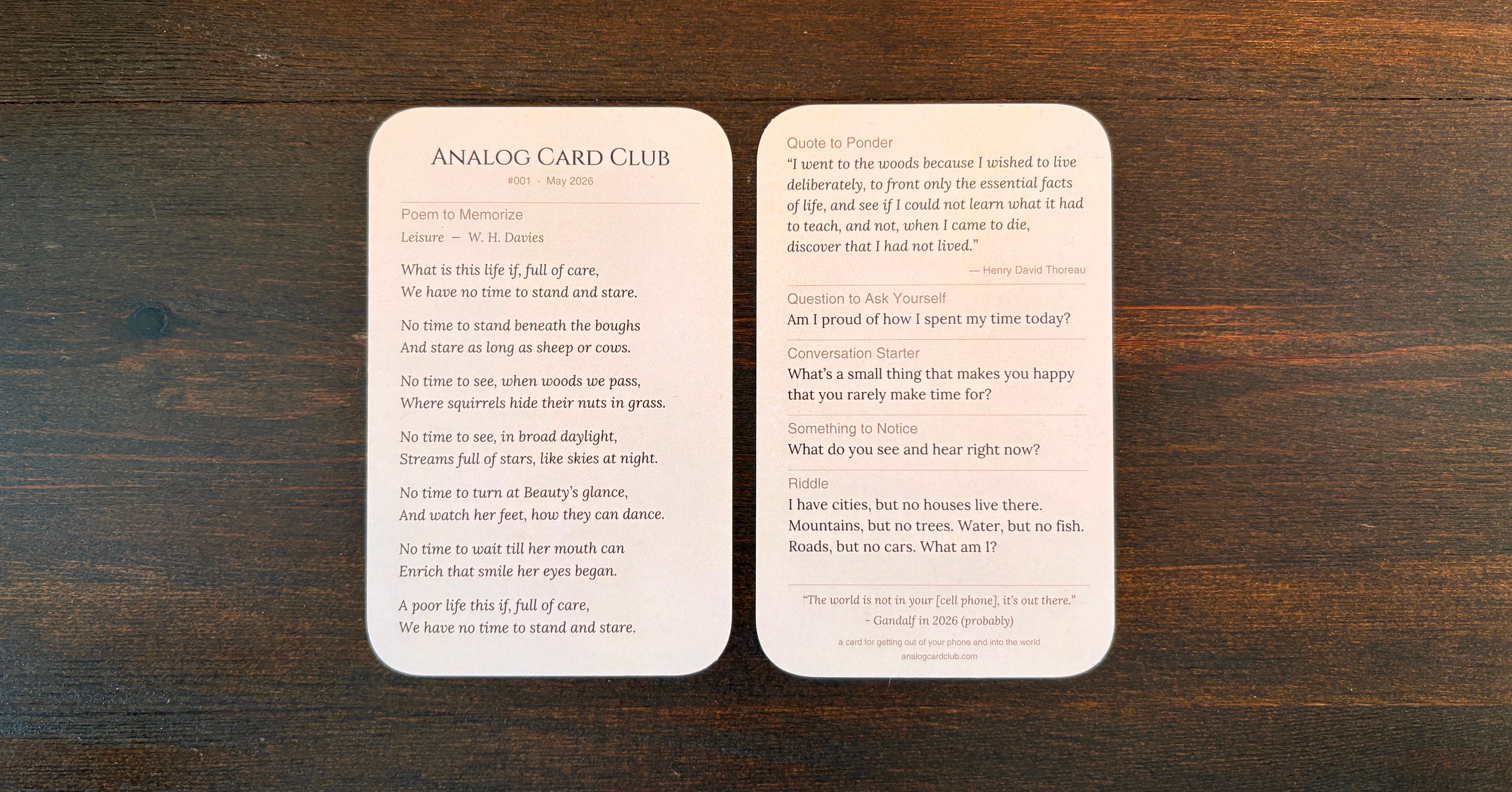
Hey Reader, I was watching the college baseball regionals with my son on Friday. (Go Gators!) Somewhere around the third inning he turned to me and said, “Dad, it’s tough to be the hitter. You don’t know where the ball is going.” “True,” I said. “But the pitcher has to throw in the strike zone. Four balls and the batter walks.” He nodded and went back to his snacks. He’s 11, so he did not stand up and start clapping, saying “great life lesson, Dad!”. But our little chat stuck with me, and I’ve been thinking about it ever since. Before I get into it—my brother Mark just started something called the Analog Card Club, and I’m a big fan. Not just because he’s my brother, but because it’s exactly the kind of thing I reach for when I’m trying to “get my head out of my apps”.
Every month he mails you a physical card with a poem, a quote, a question, a conversation starter, something to notice, and a riddle. It’s $6/month, cancel anytime. Order before June 1st (which, I just realized, is basically today) to get the June card. Check it out here. Okay. The baseball thing. 💡 One Big Idea: The Winner’s MindsetHere’s what I kept thinking about after my son’s comment. Both players face real limits. The hitter doesn’t know what’s coming. The pitcher can’t throw wherever he wants—miss the zone four times and the batter strolls to first. Neither one is in total control. But here’s the kicker: those same limits are also their advantages… if they choose to see them that way. The pitcher thinks, “He doesn’t know what I’m going to throw. I can work with that.” The hitter thinks, “He has to come to me eventually—and when he does, I’m ready.” Same situation. Same constraints. Different mindset. One of them is shrinking. The other one is swinging (or throwing). That’s the whole thing, really. The facts of the situation don’t change. What changes is whether you read your constraints as a cage or an edge. Now, I didn’t say all this to my 11-year-old over chips and guac. That’s not the goal. The goal is to plant a seed—so that the next time he’s up to bat, or the next time he’s staring down an “impossible” school assignment, some small part of him reaches for the version of the story where he has the advantage. Because here’s what I want him to understand, and what I have to keep relearning myself: you won’t hit a home run every time. You won’t get a strikeout every time. Not every post goes viral. Not every course sells out. Not every book lands on a bestseller list. I know all those personally—well except for the book part. Working on that. But if you keep a Winner’s Mindset—if you treat your limits as the very thing you can work with—you stay in the game long enough to make it count. The home run isn’t the point. Going back up to the plate (or the mound) is. 📹 Video to Watch: Tracking Your ENTIRE Life in a NotebookSpeaking of staying consistent—you all know I love the constraints of paper. Peter McKinnon made a video on tracking your entire life in a notebook, even with every digital tool on the planet sitting in your pocket. He, Casey Neistat, and John Grimsmo all share how they journal, and you should watch John’s time-tracking method around the 10:07 mark. I’m not saying my videos inspired him… but it does look awfully familiar. Watch on YouTube. 📰 Book to Read: The 7 Rules of PowerHere’s the uncomfortable cousin of the Winner’s Mindset: power. Many people treat it as distasteful, something to keep at arm’s length or only for the power-hungry. But the reality is that someone is going to wield power regardless—so it might as well be someone trying to use it for good. Jeffrey Pfeffer’s book pairs well with everything above: winning is partly about not flinching from the pursuit of victory. Read it on Amazon Thanks for reading the WRAP! Talk soon, Matt Ragland |